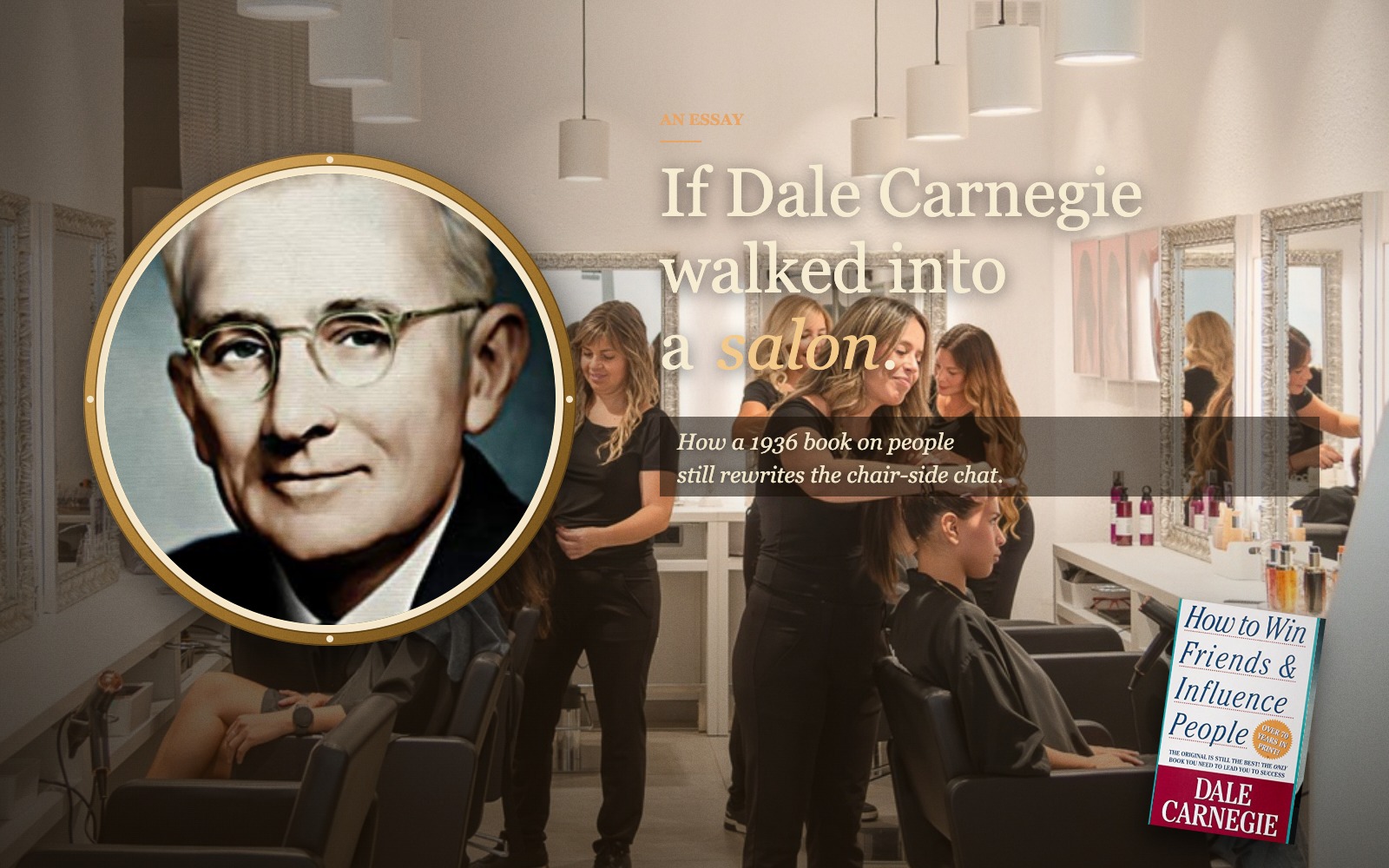
I was working with a group of salon owners recently on how to make more of the conversations they and their team have with clients. The same handful of questions get asked at almost every visit. The aim was to take those predictable questions and pair each one with an answer that steers the conversation toward something useful, instead of closing it down and moving on on autopilot.
Those small moments are not ambient noise. They are the single most under used asset in any salon. Done on autopilot, they fill time. Done with purpose, they change the business.
About halfway through, I realised I was retreading ground.
The book that already wrote it
Almost everything I was describing, the small shifts in language, the demonstration in place of explanation, the warm beginning, the assumptive close, had already been written. Not for salons. Not even for this century. In 1936, Dale Carnegie published How to Win Friends and Influence People, and ninety years later, more than 30 million copies in, it is still in print.
Carnegie never set foot in a salon. He was thinking about salespeople, executives, parents, public speakers. But the principles he laid down map, almost word for word, onto what happens behind a chair every day.
So I wrote a thought experiment. If Dale Carnegie were alive today, and you handed him a coffee and walked him through a busy Saturday morning in a good salon, what would he see? What chapter would he write?
Why the salon is the perfect room
Carnegie spent his life arguing that real influence happens in calm, undivided, one to one conversations. The harder you push, the more people lean back. The more genuinely interested you are in them, the more naturally they lean in.
Now look at what a stylist has. Anywhere from thirty minutes to several hours of one to one time with a client who is not distracted and not in a hurry. Established trust, because the client has chosen to come back. A natural rhythm of conversation, because clients ask the same handful of questions every visit. There is no environment in modern commerce better suited to Carnegie’s principles. A call centre cannot do it. A shop floor cannot do it. An online ad cannot do it. None of them come close.
And yet, in lots of salons, the conversation runs on autopilot. Fine thanks, you closes the door before anything has started.
The autopilot problem
The stylist is not lazy. The reason the conversation defaults is not effort, it is preparation. Nobody has handed the team a slightly better answer to the questions they get asked dozens of times a day. So they reach for the answer that requires nothing of anybody, which is fine thanks, you, and the moment passes.
The other reason it defaults is that almost every attempt to fix it has been framed as sales training. Owners call a team meeting and announce that everyone needs to start asking clients for reviews and recommending products. The team nods, leaves, and nothing changes. Or worse, clients start to feel a small pressure that was not there before, and the team start to dread the parts of the visit they used to enjoy.
Carnegie understood this nearly a century ago. The moment a person feels they are being sold to, they stop listening. So the question is not how to sell better in a salon. It is how to have a better conversation, knowing that the conversation is what does the work.
The only way on earth to influence other people is to talk about what they want and show them how to get it.
Dale Carnegie
How reviews get talked into existence
The essay walks through four worked examples in detail. Reviews, referrals, rebooking, retail. One taste here.
Take Google reviews. Every salon owner I have spoken to wants more of them, and almost no salon is using the conversation to get them.
The first route, the one lots of salons try, is asking. Could you leave us a review when you get home? It works sometimes. It makes everybody slightly uncomfortable every time.
The second route is the Carnegie one. The stylist does not ask. They answer questions they were going to be asked anyway, with answers that mention, in passing, that reviews exist and that they matter.
How are you? gets replaced with really good actually, we had a lovely review come in last night that made everyone smile. The client now knows reviews come in, that they are noticed, and that they matter. Some leave the chair thinking nothing of it. Some leave thinking they should write one. None feel asked.
The same five questions get asked every day. The autopilot answers do nothing. The strategic ones, repeated quietly across a small team, are how reviews get talked into existence.
Five strategic answers, written out in full, are in how to get more Google reviews without asking. The same shape, applied to referrals, is in how to get more referrals without asking.
The retail gap nobody talks about
The biggest opportunity in the essay sits with retail. The figure is worth pausing on.
100% of salon clients buy hair products. Every single one of them. Shampoo, conditioner, something to style with, often something to protect with. Around 95% of them buy those products somewhere other than the salon they sit in.
The person they trust to advise them on their hair is the one holding the brush. The product they would benefit from is the one being used on them. And almost all of them walk past it on the way out and buy something else on a Tuesday in Boots.
The gap is not because the product is wrong. It is because the conversation around it never happened.
Read the full essay
The complete piece runs to fourteen pages. It covers the nine Carnegie principles translated into the chair, the team meeting script, and detailed worked examples for the four outcomes salons care about: reviews, referrals, rebooking and retail. Five strategic answers for each.
Enter your name and email below to read it in full. I will email you the link too, so you can find it again later.
Comments
Type your name, email, and message. No account needed.